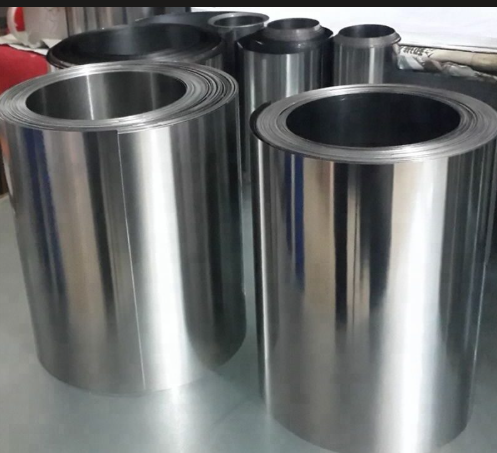
The premium cost of SS 904L shim material makes it one of the most frequently misidentified or substituted stainless steel grades in industrial supply chains. Whether caused by accidental warehouse mix-ups, documentation errors, or deliberate material substitution, receiving the wrong grade can result in severe operational and financial consequences.
One of the most common substitutions involves replacing SS 904L with SS 316L due to the significant difference in raw material costs. While both grades are austenitic stainless steels, their corrosion resistance capabilities differ dramatically in aggressive environments containing sulfuric acid, chlorides, and other corrosive media.
To prevent costly failures, industrial quality control teams rely on Positive Material Identification for stainless steel as the industry-standard verification method. PMI testing provides a fast, non-destructive way to confirm that incoming shim stock matches the specified material grade before fabrication or installation.
Why Material Substitution Happens with SS 904L Shims ?
The Cost and Performance Gap Between 316L and 904L
Material substitution often occurs because SS 904L contains substantially higher levels of expensive alloying elements, particularly Nickel and Molybdenum. These elements significantly increase production costs compared to conventional stainless-steel grades such as 316L.
For suppliers operating in competitive markets, the temptation to mislabel material can be substantial. In some cases, procurement teams may unknowingly receive incorrectly tagged inventory from upstream distributors.
The consequences of installing the wrong material can be severe. SS 904L is specifically engineered for highly corrosive environments where standard stainless steels may fail. In sulfuric acid processing plants, desalination systems, chemical reactors, and offshore installations, substituting 316L for 904L can lead to:
- Premature pitting corrosion
- Crevice corrosion failures
- Acid leakage incidents
- Unplanned maintenance shutdowns
- Reduced equipment service life
- Significant safety risks
For critical applications, PMI verification should never be considered optional.
The Chemical Blueprint: What Makes SS 904L Unique?
Key Elements to Look for on Your PMI Screen
Understanding the SS 904L chemical composition is essential when interpreting PMI results. SS 904L, also known as UNS N08904, contains a unique combination of alloying elements that provide exceptional corrosion resistance.
When performing PMI testing, inspectors should focus on four primary elements:
- High Nickel (23–28%)
- Chromium (19–23%)
- High Molybdenum (4–5%)
- Copper (1–2%)
Among these, Copper is often the most important identifier because it is largely absent in SS 316L and many other stainless-steel grades
SS 316L vs 904L PMI Comparison Table
Element | SS 316L (%) | SS 904L (UNS N08904) (%) | Why It Matters for PMI |
Nickel (Ni) | 10.0 – 14.0 | 23.0 – 28.0 | Doubles in 904L; primary cost driver. |
Chromium (Cr) | 16.0 – 18.0 | 19.0 – 23.0 | Improves corrosion resistance. |
Molybdenum (Mo) | 2.0 – 3.0 | 4.0 – 5.0 | Vital for pitting resistance. |
Copper (Cu) | Traces / None | 1.0 – 2.0 | The definitive fingerprint element for 904L. |
Iron (Fe) | Balance | Balance | Base metal component. |
When reviewing PMI results, the combination of elevated Nickel, elevated Molybdenum, and measurable Copper content serves as a strong confirmation that the material is genuine SS 904L.
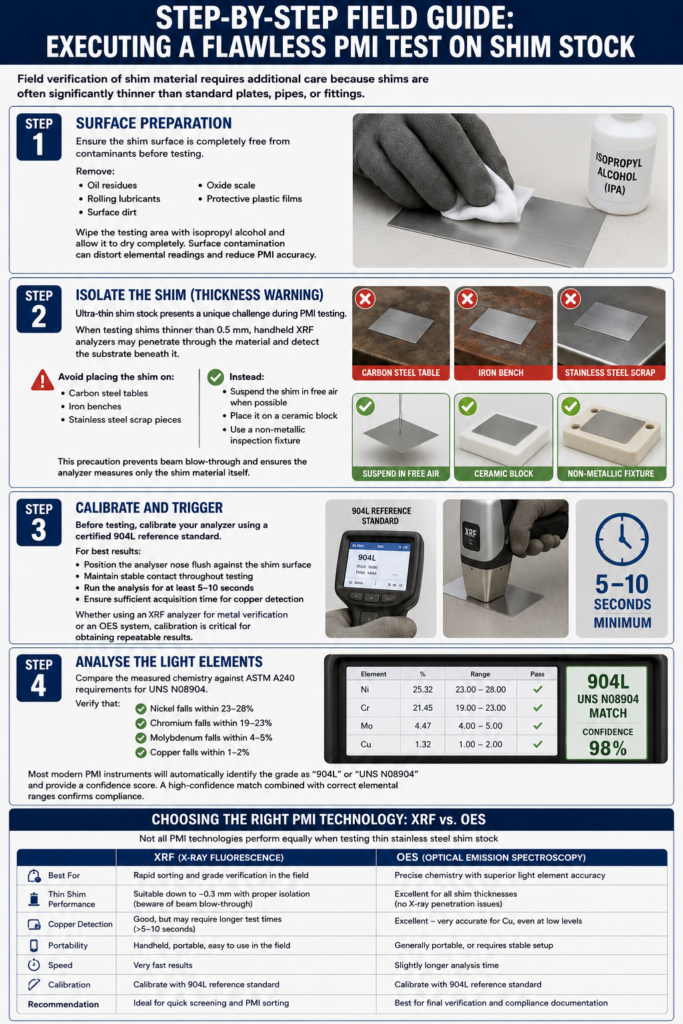
Choosing the Right PMI Technology: XRF vs. OES
Not all PMI technologies perform equally when testing thin stainless steel shim stock. The two most commonly used methods are X-Ray Fluorescence (XRF) and Optical Emission Spectroscopy (OES), each offering distinct advantages depending on the inspection requirements.
X-Ray Fluorescence (XRF) Analyzers
XRF analyzers are the preferred choice for most field inspections because they provide fast, non-destructive material verification. These handheld devices are highly portable, making them ideal for incoming material inspection, warehouse verification, and on-site quality control. They require minimal operator training and deliver immediate results, which helps reduce inspection time and improve efficiency.
However, XRF technology has limitations. It cannot accurately measure carbon content and may produce less reliable readings when testing extremely thin shim materials if proper backing isolation is not used. Despite these limitations, handheld XRF remains the industry-standard solution for routine SS 904L shim verification.
Optical Emission Spectroscopy (OES)
OES provides a higher level of analytical accuracy and can measure carbon content precisely, making it valuable for laboratory testing and critical material verification. This method is often used when detailed chemical analysis is required or when PMI results need additional confirmation.
The primary drawbacks of OES are that it leaves a microscopic burn mark on the test surface, requires argon gas for operation, and is less portable than XRF equipment. Additionally, testing ultra-thin shim stock can be more challenging. As a result, OES is typically reserved for laboratory certification, dispute resolution, or applications where exact carbon measurement is essential.
OES is often reserved for final dispute resolution or laboratory-based material certification.
✓ Verify Molybdenum content: 4–5%
✓ Verify Copper content: 1–2%
✓ Confirm instrument identifies grade as UNS N08904 / 904L
✓ Document results in inspection report
✓ Approve material only after chemistry and traceability verification
Beyond PMI: Essential Trust Signals in 904L Procurement
While PMI testing is extremely effective, it should be only one component of a comprehensive quality assurance process.
How to Read a Mill Test Certificate (MTC) for 904L
Every shipment should include a valid Mill Test Certificate.
Look for:
- EN 10204 3.1 certification minimum
- EN 10204 3.2 certification for critical projects
- Complete chemical analysis
- Mechanical property data
- Heat number traceability
Always compare the heat number on the certificate with markings on the shim coil, roll, or packaging any discrepancy should trigger further investigation.
Red Flags When Sourcing from Suppliers
Procurement teams should remain cautious when evaluating suppliers.
Common warning signs include:
- Prices significantly below market averages
- Missing MTC documentation
- Incomplete traceability records
- Reluctance to provide sample testing
- Resistance to independent third-party PMI verification
- Inconsistent material markings
Reliable suppliers’ welcome verification because it strengthens confidence in their quality systems. Verifying genuine SS 904L shim material requires more than simply reviewing paperwork. A properly executed PMI inspection provides immediate confirmation that the material contains the correct alloy chemistry required for demanding industrial service. By focusing on Nickel, Molybdenum, and especially Copper content, inspectors can quickly distinguish genuine SS 904L from lower-cost substitutes such as 316L. Combining PMI testing with traceable Mill Test Certificates and reputable sourcing practices creates a robust quality control framework that protects equipment, personnel, and project budgets.
SS 904L PMI Inspection Checklist (SOP Ready)
✓ Verify Mill Test Certificate availability
✓ Confirm EN 10204 3.1 or 3.2 certification
✓ Match heat number with supplied material
✓ Clean shim surface before testing
✓ Remove oils, coatings, and contaminants
✓ Isolate thin shim stock from metallic backing surfaces
✓ Calibrate analyzer using certified 904L reference standard
✓ Conduct PMI scan for at least 5–10 seconds
✓ Verify Nickel content: 23–28%
✓ Verify Chromium content: 19–23%