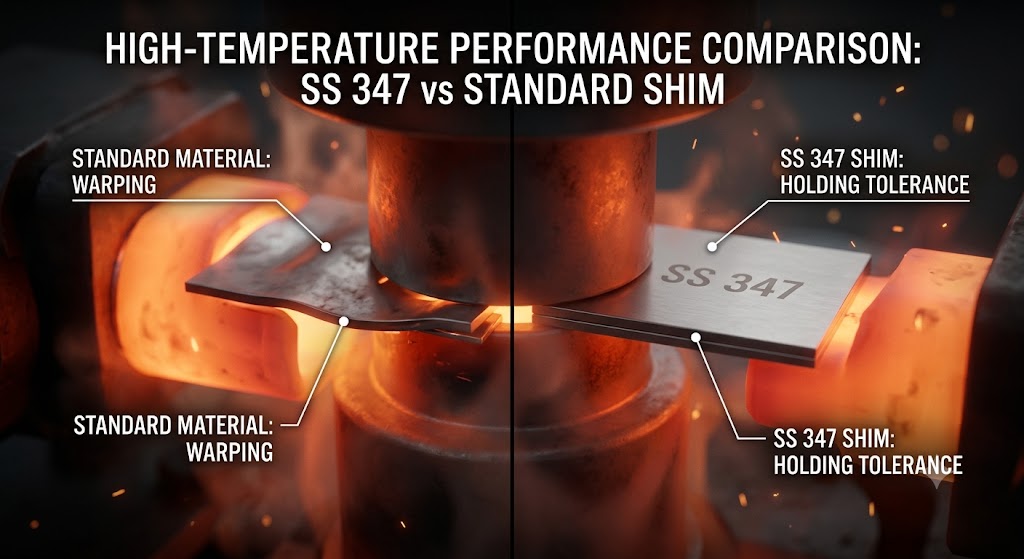
The Challenge of High-Temperature Environments
In industries where heavy machinery operates under extreme heat, maintaining precise alignment isn’t just about efficiency—it is a matter of safety and operational survival.
During operation, industrial components undergo thermal expansion. As temperatures fluctuate, parts shift. Even a microscopic misalignment can cause catastrophic equipment failure, unexpected downtime, and massive repair costs. Precision shims act as the critical buffer, compensating for these variations to provide accurate spacing and steadfast support.
However, standard stainless steel grades often fail under prolonged heat, becoming susceptible to carbide precipitation that destroys their corrosion resistance and structural integrity. That is where SS 347 shims step in.
Understanding the Need for High-Temperature Shims
Industrial machinery often experiences thermal expansion during operation. Components can shift slightly due to temperature fluctuations, creating alignment issues that affect performance and equipment lifespan. Precision shims help compensate for these variations by providing accurate spacing and support.
However, not all shim materials can withstand prolonged exposure to heat. Standard stainless steel grades may become susceptible to carbide precipitation, which can reduce corrosion resistance and compromise structural integrity over time.
What Sets SS 347 Shims Apart?
SS 347 is a premium, stabilized austenitic stainless steel grade. Its secret weapon is the addition of niobium (columbium). This stabilization prevents the formation of chromium carbide during continuous high-temperature service and critical welding operations.
When you upgrade to [Link to your SS 347 product page: SS 347 shims], your facility benefits from:
-
Total Thermal Stability: Unyielding performance even in cyclic heating environments.
-
Superior Corrosion Resistance: Complete protection against intergranular corrosion.
-
Long-Term Dimensional Accuracy: Shims that hold their shape and thickness under extreme stress.
-
Reduced Maintenance Costs: Fewer machinery breakdowns and a significantly lower replacement frequency.
Key Industries Relying on SS 347 Shims
Because reliability is non-negotiable, several critical sectors depend exclusively on SS 347 to maintain equipment performance:
Petrochemical & Chemical Processing
Refining equipment constantly battles a brutal combination of extreme temperatures and highly corrosive media. SS 347 shims ensure accurate component positioning without degrading over time, keeping plants running safely and efficiently.
Power Generation Facilities
From massive steam turbines to commercial boilers and heat recovery systems, power generation requires materials that can handle continuous, unforgiving thermal stress. SS 347 delivers the exact stability needed for long-term, uninterrupted operation.
Aerospace Manufacturing
Aircraft engines and high-heat exhaust systems demand lightweight materials that retain their strength and resist oxidation at high altitudes and temperatures. SS 347 is a strictly trusted grade for these high-stakes applications.
How to Choose a Trustworthy Shim Manufacturer?
When sourcing critical components, choosing the right manufacturing partner is just as important as the material itself. Sourcing strictly on price can lead to supply chain delays or machinery failure.
Always look for a supplier that guarantees:
-
Strict Standard Compliance: Full adherence to ASTM and ASME specifications.
-
Certified Traceability: Provision of complete Material Test Certificates (MTCs) with every batch.
-
Precision Engineering: Exacting dimensional accuracy through advanced laser cutting or stamping.
-
Custom Capabilities: The ability to produce bespoke sizes and thicknesses on demand.
Secure Your Operations with Premium SS 347 Shims
India’s rapid industrial expansion in power generation, refining, and infrastructure demands higher-performing materials. SS 347 shims are no longer just an option; they are a fundamental requirement for precision engineering in extreme environments.
Don’t let thermal expansion compromise your heavy machinery. Ensure your equipment’s alignment, reliability, and lifespan with stabilized stainless steel components designed to take the heat.