
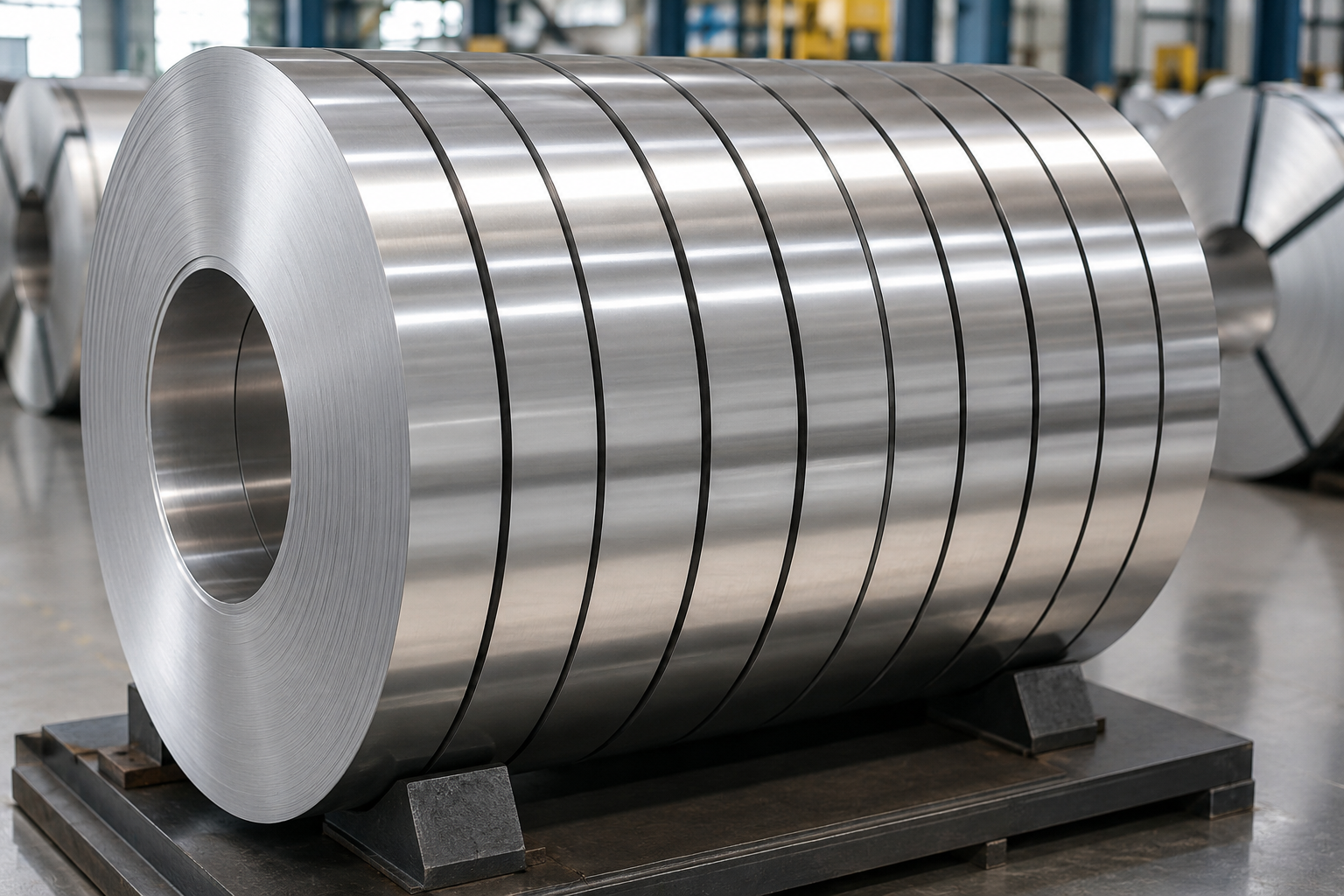
Stainless steel slitting coils are narrow strips produced by cutting a wider stainless steel master coil into specific widths. Manufacturers use these coils when their production lines require material that matches exact dimensions, eliminating the need for additional cutting before processing. Slit coils are widely used in industries such as automotive, construction, food processing, appliance manufacturing, and tube production. Since the material is supplied in the required width, manufacturers can reduce material waste, improve production efficiency, and maintain consistent product quality. The slitting process involves uncoiling a master coil, cutting it into narrower strips using rotary knives, and recoiling the finished strips into individual coils. Depending on the application, slit coils can be supplied in various grades, thicknesses, widths, and surface finishes. Whether used for automotive exhaust systems, kitchen equipment, architectural components, or welded tubes, stainless steel slitting coils provide a practical and cost-effective solution for modern manufacturing operations. What Is a Stainless-Steel Slitting Coil? A slit coil is a narrow strip of stainless steel produced by cutting a wider “mother coil” lengthwise. Unlike standard wide sheets, a slit coil is tailored to a specific, highly accurate width to feed directly into specialized manufacturing machinery. The main difference between a mother coil and a slit coil is their width and intended application. A mother coil (or master coil) is the massive, full-width steel roll produced directly by the rolling mill, typically measuring between 1,000 mm and 1,500 mm wide. Mother coils are easier to transport and store before further processing but are too wide for most production lines. A slit coil is produced by cutting a mother coil into multiple narrower strips ranging from a few millimeters to several centimeters wide to match specific factory tooling. Production Process Slit coils are manufactured through a continuous mechanical process on an industrial slitting line. Uncoiling: The heavy mother coil is mounted onto a mandrel that rotates to unfurl the steel sheet. Slitting: The flattened steel passes through a slitting head equipped with sharp, circular rotary knives. These knives are precisely spaced to shear the wide sheet into multiple narrower strips simultaneously. Tensioning & Recoiling: Because variations in the steel’s thickness can cause strips to wind unevenly, a tensioning unit applies uniform pressure across all strands. The separated strips are then wound onto an exit mandrel, forming individual slit coils ready for packaging. In high-speed manufacturing, precise width tolerance the allowable deviation from the target width is critical. Coil Width Examples: A manufacturer producing precision tubing might order slit coils with a target width of ±0.5 mm, requiring a strict tolerance of ±0.1 mm. Conversely, a less critical application, like structural brackets, might utilize a wider 300 mm slit coil with a more forgiving tolerance of pm 0.5 mm Industrial Requirements: Automated n production lines require consistent dimensions to ensure smooth operation and reliable product quality. If a slit coil is even fractionally too wide, it can jam feeding guides, shatter progressive stamping dies, or cause severe edge burrs. If it is too narrow, the final product may fail structural inspections or suffer from alignment defects during automated welding and assembly. Strict width tolerances ensure seamless machine operation and minimize costly material scrap. Stainless Steel Slitting Coil Grades Grade Features Applications SS 201 Economical, high work-hardening rate, moderate corrosion resistance. General fabrication, catering equipment, and decorative trim. SS 304 Excellent corrosion resistance, highly formable, and standard versatile grade. Food processing equipment, kitchenware, and commercial appliances. SS 304L Lower carbon content than 304, minimizing carbide precipitation for better weldability. Heavy-gauge welded components and general chemical fabrication. SS 316 Molybdenum bearing for high resistance to chlorides and marine environments. Marine hardware, chemical processing industry, and coastal architecture. SS 316L Low carbon version of 316; eliminates weld-boundary carbide precipitation. Pharmaceutical machinery, medical implants, and aggressive chemical storage. SS 321 Stabilized with titanium; exhibits excellent resistance to scaling and intergranular corrosion at high temperatures. Aircraft exhaust systems, heat exchangers, and boiler components. SS 430 Ferritic grade; good corrosion and formability characteristics, magnetic, and highly polishable. Decorative appliance panels, automotive trim, and interior architectural molding. Segmented Dimensions by Application To match specific industrial requirements, slit coils are generally categorized into three primary dimensional tiers: Ultra-Thin / Precision Strip Thickness: 0.05 mm to 0.3 mm Width: 2.0 mm to 100 mm Primary Uses: Electronic connectors, medical shims, spring clips, and precision diaphragms. Light to Medium Gauge (Standard Manufacturing) Thickness: 0.4 mm to 3.0 mm Width: 10 mm to 500 mm Primary Uses: Automotive exhaust components, kitchen appliances, tubing, and stamped brackets. Heavy Gauge Thickness: 3.1 mm to 6.0 mm (or greater on heavy-duty slitting lines) Width: 50 mm to 600 mm Primary Uses: Structural hardware, heavy machinery components, and industrial flanges. Coil Weight and ID/OD Configurations In addition to thickness and width, material handling systems require matching coil diameters and weights: Inner Diameter (ID): Standard industry sizes are 300 mm, 400 mm, 508 mm (20 inches), and 610 mm (24 inches), configured to fit the expansion mandrels of downstream production lines. Outer Diameter (OD): Typically ranges from 800 mm up to 1,800 mm, depending on the customer’s maximum lifting and uncoiling weight capacities. 1. Material Savings Ordering slit coils in the required width helps reduce scrap and eliminates additional cutting on the shop floor. 2. Improved Production Efficiency Slit coils are tailored to feed directly into specific production lines, such as automated stamping presses, roll forming machines, or tube mills. This seamless compatibility removes the need for preparatory in-house cutting, allowing production lines to operate more efficiently. 3. Better Handling Full-width mother coils are incredibly heavy and require specialized, high-capacity cranes and forklifts to move. Slit coils are narrower, lighter, and more modular, making them significantly safer and easier for operators to handle, maneuver, and store within the warehouse. 4. Reduced Processing Time By eliminating the secondary step of resizing or shearing raw material on-site, manufacturers save labor, setup time, and processing costs. Production becomes a continuous, single-stage operation where the coil is mounted