
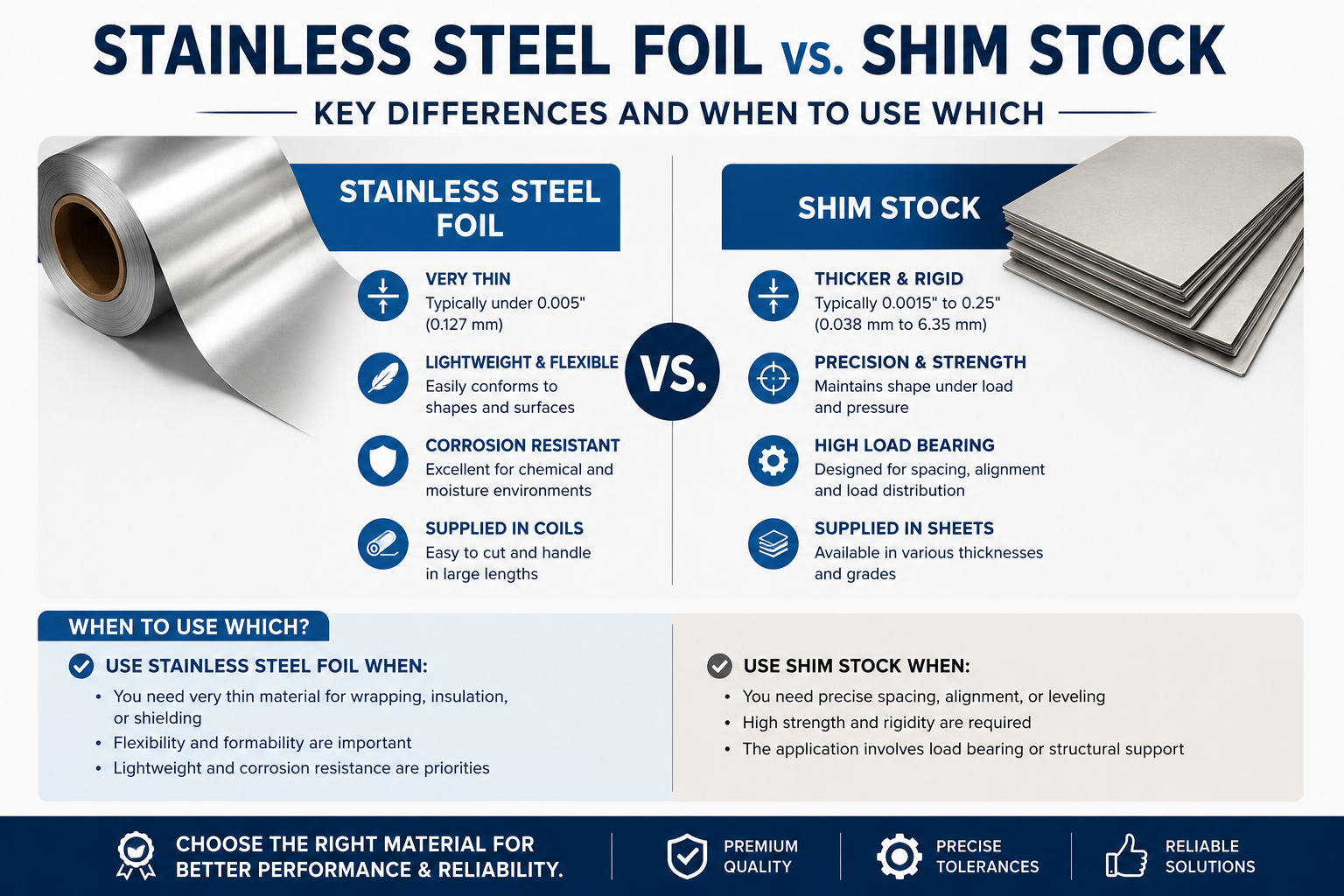
When sourcing ultra-thin metal materials for precision engineering, tooling, or thermal management, terminology can quickly become confusing. Two materials that are frequently used interchangeably—even within industrial supply chains—are stainless steel foil and stainless steel shim stock. While both products consist of thin-gauge stainless steel offering exceptional corrosion resistance, they are manufactured with vastly different objectives, temper profiles, and dimensional tolerances. Using foil in an application that requires structural shim stock can lead to component sag, creep, or catastrophic crushing under load. Conversely, using rigid shim stock where you need flexible foil can make wrapping and forming impossible. As a specialized manufacturer dedicated to high-precision metal solutions, we break down the core structural differences, mechanical behaviors, and ideal applications for both materials to help you specify the right product for your project. 1. What is Stainless Steel Foil? Stainless Steel Foil generally refers to exceptionally thin sheets or strips of stainless steel—typically under 0.005 inches (0.127 mm) thick, down to ultra-thin gauges of 0.0002 inches (0.005 mm). Foil is engineered with a primary focus on flexibility, surface integrity, heat transfer, and conformability. It is frequently supplied in softer or annealed tempers so it can be easily wrapped, folded, stamped, or molded around complex geometries without cracking. Key Characteristics of Stainless Steel Foil: Thickness Range: Ultra-thin (<0.0002″ to ~0.005″ / 0.005 mm to 0.127 mm). Primary Temper: Annealed, soft, or quarter-hard (highly flexible and malleable). Core Advantages: High thermal stability, oxidation resistance, electrical/EMI shielding, and extreme conformability. 2. What is Stainless Steel Shim Stock? Stainless Steel Shim Stock is precision-rolled coil, strip, or sheet material engineered specifically for gap adjustment, alignment, levelling, and mechanical tolerance compensation in heavy-duty or precision systems. Unlike general foil, shim stock is almost universally produced in a full-hard or spring temper (such as 304 or 301 Full-Hard Stainless). This processing gives the material high yield strength and spring-back capabilities, ensuring it resists permanent deformation or crushing when squeezed between heavy metal components under high torque or clamping loads. Key Characteristics of Stainless Steel Shim Stock: Thickness Range: Micro-thin to semi-rigid (0.0005″ to >0.030″ / 0.0125 mm to 0.8 mm+). Primary Temper: Full-hard / Spring temper (rigid, highly elastic, and resistant to compression). Core Advantages: Exceptional compressive strength, strict thickness tolerances across the entire length, and minimal deformation under load. 3. Side-by-Side Comparison Feature Stainless Steel Foil Stainless Steel Shim Stock Primary Engineering Purpose Barrier protection, sealing, heat dissipation, EMI shielding. Precision spacing, machinery alignment, gap filling. Typical Temper Soft / Annealed / $frac{1}{4}$ Hard. Full-Hard / Spring Temper. Compressive Resistance Low to Moderate (prone to deformation under heavy torque). Very High (withstands intense structural loading). Workability Easily bent, folded, or cut with fine shears or stamping dies. Rigid; requires precision laser cutting, stamping, or shearing. Thickness Tolerance Standard commercial mill tolerances. High-precision tighter tolerances for exact engineering fits. Common Alloys 304, 316L, 310S, 321. 304, 316, 301 (or 1095 Spring Steel). When to Use Stainless Steel Foil Specify stainless steel foil when your application requires environmental protection, thermal management, or tight wrap-around flexibility rather than structural load-bearing capacity. Ideal Industrial Applications: Thermal & EMI Shielding: Wrapping heat-sensitive elements in aerospace, automotive, or electronics to reflect radiant heat or block electromagnetic fields. Heat Treat Tooling Wrap: Enclosing air-hardening tool steels during high-temperature vacuum or atmosphere heat treatment to prevent surface scaling and decarburization. Diaphragms & Gaskets: Flexible sealing components in chemical or medical equipment where chemical inertness and high conformability are mandatory. Exhaust & Insulation Barriers: Molded or creased insulation wrap layers used in high-performance exhaust headers. 5. When to Use Stainless Steel Shim Stock Specify stainless steel shim stock when your primary objective is mechanical precision, component levelling, or filling structural gaps under load. Ideal Industrial Applications: Machinery Alignment: Correcting angular or parallel offset between heavy electric motors, pumps, and industrial gearboxes. Tool and Die Setup: Fine-tuning punch press clearances and mold height settings in manufacturing environments. Bearing Preload & Wear Compensation: Taking up mechanical play caused by long-term operational wear in rotating equipment. Base Plate Levelling: Supporting industrial machinery feet on uneven foundations without risking long-term creep or material compaction. Expert Selection Tips from the Manufacturer Golden Rule of Specification: If you need to bend, wrap, or fold the material over a tight radius without spring-back, choose Stainless Steel Foil (Annealed). If you are placing the material between two torqued metal faces to establish an exact structural distance, choose Stainless Steel Shim Stock (Full-Hard) to eliminate crushing. Select the Right Alloy: Grade 304 / 304L serves as the universal industry standard for general industrial shims and foils due to its balanced formability and corrosion resistance. Upgrade to 316 / 316L if your application involves marine environments, saltwater exposure, or harsh chemical processing Prioritize Edge Quality: Because full-hard shim stock is rigid, burrs on sheared edges can throw off critical thickness stacks. Ensure your supplier provides precision-slit or deburred edges for high-tolerance assemblies.