
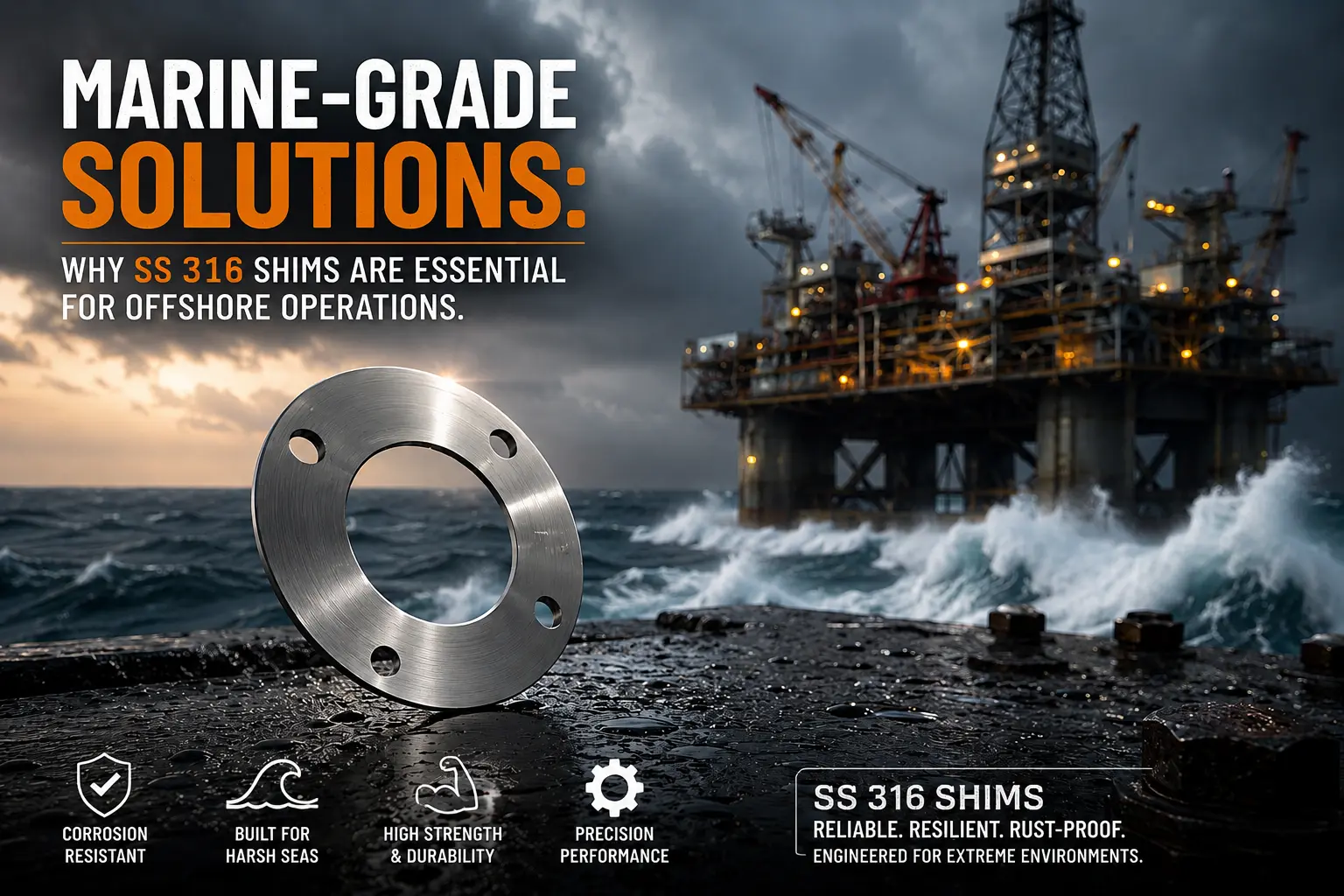
When it comes to offshore oil rigs, marine vessels, and coastal industrial plants, the environment is unforgiving. Equipment faces a constant, relentless assault from saltwater, high humidity, wind, and extreme thermal stress. In these conditions, even the smallest component failure can lead to catastrophic downtime. That includes your shims. When aligning heavy rotating machinery like pumps, compressors, and generators offshore operators can’t afford to cut corners on materials. That’s why Stainless Steel (SS) 316 isn’t just a recommendation for marine environments; it’s an absolute necessity. Here is exactly why SS 316 shims are the gold standard for offshore and marine operations The Science of Survival: What Makes SS 316 Different? At first glance, standard SS 304 and marine-grade SS 316 look identical. They are both strong, durable, and highly useful in industrial applications. However, the secret to SS 316’s superiority lies in its chemical composition—specifically, the addition of Molybdenum. SS 316 contains 2% to 3% molybdenum, which acts as a powerful shield against a specific, highly destructive threat: chloride corrosion. In saltwater environments, chlorides quickly attack standard stainless steel, causing localized pitting and crevice corrosion. Molybdenum hardens the steel’s passive oxide layer, drastically increasing its resistance to these coastal elements. Where SS 316 Shims Prove Their Worth Offshore platforms rely on massive, high-vibration machinery that must remain perfectly aligned to operate safely and efficiently. SS 316 shims are typically deployed in: Pumping Systems: Ensuring precise alignment for high-capacity seawater and crude oil pumps. Power Generation: Leveling diesel generators and turbines that power the entire offshore facility. Propulsion Systems: Securing and aligning drive shafts and marine engines where saltwater exposure is a daily reality. Winch and Crane Mounts: Providing stable, load-bearing support for heavy lifting equipment exposed to sea spray. SS 316 contains 2% to 3% molybdenum, which acts as a powerful shield against a specific, highly destructive threat: chloride corrosion. In saltwater environments, chlorides quickly attack standard stainless steel, causing localized pitting and crevice corrosion. Molybdenum hardens the steel’s passive oxide layer, drastically increasing its resistance to these coastal elements. The Hidden Cost of “Good Enough” Materials Procurement teams are often tempted to use SS 304 shims to save a few pennies upfront. In a dry, indoor facility, 304 is a fantastic choice. Offshore, it’s a ticking time bomb. Using non-marine-grade shims in a saltwater environment leads to rapid oxidation and rust. When a shim rusts, it flakes and degrades, causing a loss of thickness. Just a few thousandths of an inch of degradation can result in: Soft Foot: Uneven mounting that creates severe vibration. Bearing Failure: Misalignment places uneven stress on bearings, cutting their lifespan in half. Catastrophic Downtime: A $5 rusted shim can take a multi-million-dollar pump offline, costing thousands of dollars per hour in lost production. Investing in SS 316 shims is not an added expense; it is a cheap insurance policy against catastrophic machinery failure. Precision Matters Just as Much as the Material Having the right material is only half the battle. A marine-grade shim is useless if it isn’t manufactured to exact tolerances. In offshore alignments, you are often dealing with microscopic adjustments. You need shims that are strictly quality-controlled, burr-free, and stamped with perfect flatness to ensure complete surface-to-surface contact. Whether you need standard pre-cut slotted shims for a motor footprint or custom-manufactured profiles for specialized marine equipment, precision stamping guarantees the alignment holds firm under pressure. Secure Your Offshore Machinery with Confidence When it comes to offshore oil rigs, marine vessels, and coastal industrial plants, the environment is unforgiving. Equipment faces a constant, relentless assault from saltwater, high humidity, wind, and extreme thermal stress. In these conditions, even the smallest component failure can lead to catastrophic downtime. That includes your shims. When aligning heavy rotating machinery—like pumps, compressors, and generators—offshore operators can’t afford to cut corners on materials. That’s why Stainless Steel (SS) 316 isn’t just a recommendation for marine environments; it’s an absolute necessity. Here is exactly why SS 316 shims are the gold standard for offshore and marine operations https://youtu.be/vsCMomY8Og8 The Science of Survival: What Makes SS 316 Different? At first glance, standard SS 304 and marine-grade SS 316 look identical. They are both strong, durable, and highly useful in industrial applications. However, the secret to SS 316’s superiority lies in its chemical composition—specifically, the addition of Molybdenum. SS 316 contains 2% to 3% molybdenum, which acts as a powerful shield against a specific, highly destructive threat: chloride corrosion. In saltwater environments, chlorides quickly attack standard stainless steel, causing localized pitting and crevice corrosion. Molybdenum hardens the steel’s passive oxide layer, drastically increasing its resistance to these coastal elements. Where SS 316 Shims Prove Their Worth Offshore platforms rely on massive, high-vibration machinery that must remain perfectly aligned to operate safely and efficiently. SS 316 shims are typically deployed in: Pumping Systems: Ensuring precise alignment for high-capacity seawater and crude oil pumps. Power Generation: Leveling diesel generators and turbines that power the entire offshore facility. Propulsion Systems: Securing and aligning drive shafts and marine engines where saltwater exposure is a daily reality. Winch and Crane Mounts: Providing stable, load-bearing support for heavy lifting equipment exposed to sea spray. SS 316 contains 2% to 3% molybdenum, which acts as a powerful shield against a specific, highly destructive threat: chloride corrosion. In saltwater environments, chlorides quickly attack standard stainless steel, causing localized pitting and crevice corrosion. Molybdenum hardens the steel’s passive oxide layer, drastically increasing its resistance to these coastal elements. The Hidden Cost of “Good Enough” Materials Procurement teams are often tempted to use SS 304 shims to save a few pennies upfront. In a dry, indoor facility, 304 is a fantastic choice. Offshore, it’s a ticking time bomb. Using non-marine-grade shims in a saltwater environment leads to rapid oxidation and rust. When a shim rusts, it flakes and degrades, causing a loss of thickness. Just a few thousandths of an inch of degradation can result in: Soft Foot: Uneven mounting that creates severe vibration. Bearing Failure: Misalignment places uneven stress